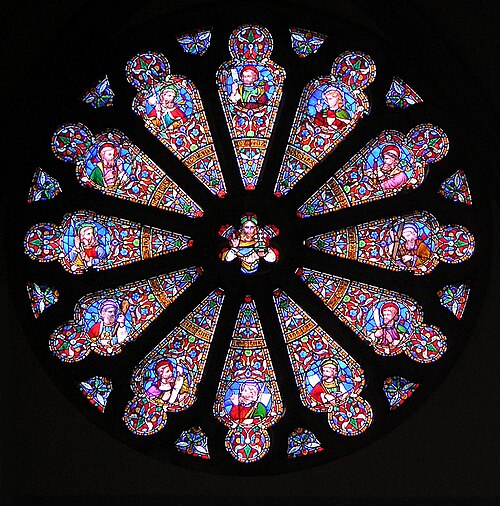

During a visit to the Cathedral of St. Thomas More in Arlington, Virginia, I learned something that has stayed with me ever since. The guide explained that, in the medieval tradition, the great rose window was understood to symbolize a well-ordered soul. Every piece of stained glass radiates from a single center. Every color, every shape, every line has its proper place. Nothing competes for the center because Christ occupies it. That image has lingered in my mind.

Perhaps that is because so much of modern life feels like the opposite of a rose window. Our calendars are overcrowded. Our homes become cluttered. Our thoughts race from one obligation to the next. We spend our days reacting instead of intentionally living. Yet God is definitely not the author of chaos.

From the opening pages of Genesis, we encounter a God who brings order out of disorder. He separates light from darkness, sea from land, day from night. He creates with purpose, beauty, and harmony. Throughout Scripture we see that holiness is not merely about avoiding sin—it is about allowing every part of our lives to be rightly ordered toward God.

St. Augustine wrote about the ordo amoris, the right ordering of our loves. Our lives become disordered when we love lesser things more than greater things. We become anxious when temporary concerns replace eternal priorities. Peace comes when God is firmly at the center and everything else finds its proper place around Him.
That is exactly what the rose window depicts. Every piece belongs. Every piece matters. But none of them belongs in the center except Christ.
Order Begins in the Soul

It is tempting to think that becoming organized starts with buying better storage bins, creating prettier planners, or finding the perfect cleaning schedule, but true order begins much deeper than that. If my prayer life is neglected, it doesn’t matter how color-coded my calendar is. If I rush into work before placing the day in God’s hands, I often spend the rest of the day chasing urgency instead of responding to His invitations.

The order of our day reflects the order of our hearts. This doesn’t mean every day unfolds perfectly. Life with children, aging parents, demanding jobs, and unexpected interruptions is beautifully unpredictable. But even within that unpredictability, our souls can remain ordered when we continually return to the true center.
Prayer first. Then work. Then everything else flows from that.

The ancient Benedictine motto, Ora et Labora—pray and work—reminds us that our labor bears the most fruit when it flows from communion with God rather than anxiety.
Rightly Ordering Our Works
One practical way I have begun applying this idea is by changing how I make my daily to-do list. Instead of asking, What do I have to get done today? I try to ask, What has God entrusted to me today? Those are not always the same question.

Sometimes the most fruitful thing I accomplish is not the longest list of completed tasks, but patiently listening to a child, making time for a friend, sitting with someone who is hurting, or lingering a few extra minutes in prayer. Productivity is not the same as fruitfulness.
A well-ordered life is not simply one in which everything gets done. It is one in which the right things are done in the right order for the right reasons.

This is why writing a daily list can actually become a spiritual practice.
When we write things down, prioritize them, and intentionally order our day, we are not merely becoming more efficient. We are setting first things first. We quiet the mental clutter that constantly competes for our attention. We let God and His priorities take the lead. Prayer first. Then work.
External order is the fruit of internal order.
The Home Reflects the Heart
I’ve noticed something else. When my mind feels scattered, my home often follows. Laundry piles grow. Papers accumulate. The kids’ spaces become chaotic. Not intentionally, but that is just what happens when you have too many things on your plate.

It’s not because I don’t know how to clean. It’s not because I don’t care. It’s because my attention has become fragmented. Other priorities have superseded that one.
Conversely, when my prayer life is grounded and my priorities are clear, keeping the house in order feels less like an endless battle and more like a natural extension of the peace God is cultivating within me.
Our homes don’t need to be perfect. But they can become places where order reflects love. Every object has a home. Every routine has a purpose. Every family member contributes according to their ability.

This kind of order is not about perfectionism. It is about faithfulness. Hospitality. Peace. Order allows our homes to become places where people can rest, where children know what to expect, where family life unfolds with tranquility.
Maria Montessori Understood This Well
Maria Montessori observed that children possess a profound love for order. She recognized that children thrive when their environments are beautiful, predictable, and intentionally arranged. Shelves are organized. Materials have designated places. Routines remain consistent. The external environment supports the child’s internal development. This wasn’t merely about neatness. Montessori believed that external order helps the child construct internal order.

As adults, we are not so different. When our desks, kitchens, schedules, and routines have a place for everything, our minds expend less energy managing chaos and more energy attending to what truly matters. Order frees us. Not because every room is Pinterest worthy, but because our attention is no longer constantly divided.
Bringing Order Into the World
Perhaps this is one of the quiet ways Christians evangelize. Not simply through grand gestures, but by becoming people whose lives radiate peace. When Christ is truly at the center, people notice. Our words become gentler. Our decisions become wiser. Our homes become more welcoming. Our work becomes more intentional. Our children learn stability. Our neighbors experience hospitality.

Like the rose window, our lives begin reflecting the One who occupies the center.
We live in a culture that often glorifies busyness, clutter, and constant distraction. But Christians are called to witness to another way—a way of peace, purpose, and rightly ordered love. The goal isn’t control. It isn’t perfection. It isn’t having the cleanest home or the cutest planner.

The goal is to become the kind of person whose whole life is arranged around Christ. When He occupies the center, everything else begins to find its proper place.
Like the pieces of a great cathedral’s rose window, our prayers, our work, our homes, our families, our responsibilities, and even our ordinary daily tasks become part of something beautiful. Not because they are perfect. But because they are rightly ordered toward the One for whom they were created.